
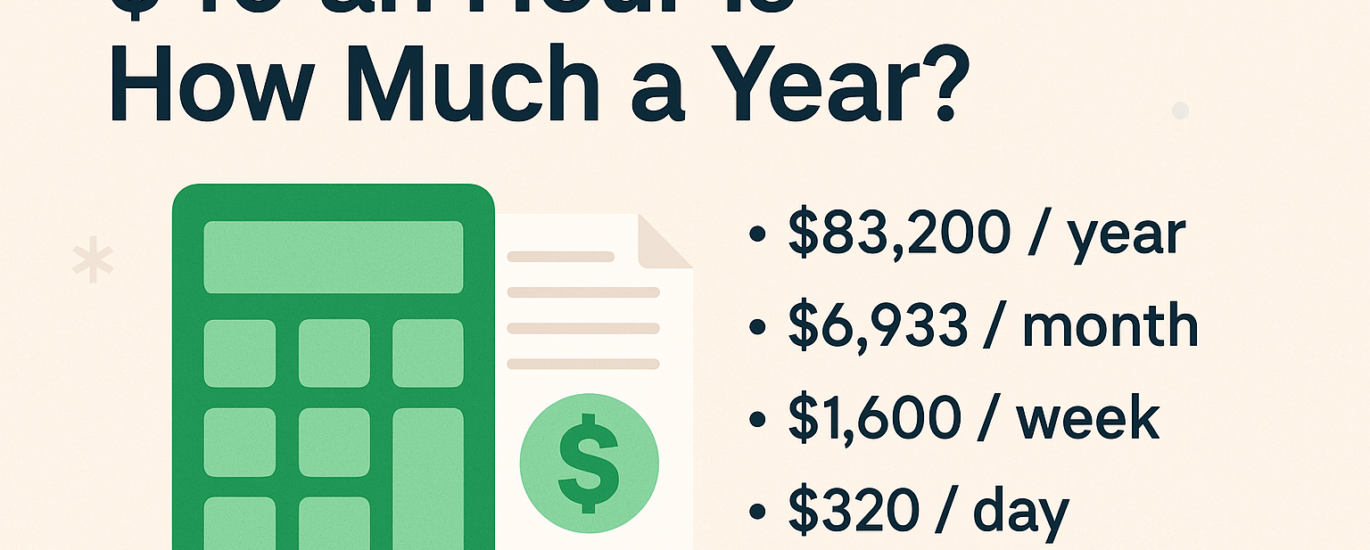
If you’re wondering “$40 an hour is how much a year?” — the simple answer is $83,200 per year, assuming you work 40 hours a week for 52 weeks. This hourly to yearly salary conversion is useful whether you’re job hunting, budgeting, or negotiating a raise. A $40 per hour wage puts you well above the U.S. national average salary, making it a strong income in most regions. At AI Pocket Tools, we break down these earnings to help you make smarter financial decisions. In this article, we’ll cover what $40/hour really means monthly, weekly, daily — and after taxes.
Quick Answer — Annual, Monthly, Weekly, and Daily Pay
At $40 an hour, your estimated annual salary is $83,200. That breaks down to about $6,933 per month, $1,600 per week, and $320 per day (based on 8-hour days). These numbers assume full-time work with no unpaid time off. Whether you’re comparing jobs or planning your budget, this hourly to yearly salary breakdown helps you understand your income clearly. It’s a solid wage in many industries and above the U.S. average income.
| Time Period | Gross Pay |
|---|---|
| Yearly | $83,200 |
| Monthly | $6,933.33 |
| Biweekly | $3,200 |
| Weekly | $1,600 |
| Daily | $320 (8 hours/day) |
| Hourly | $40 |
All values are based on a standard 40-hour workweek and 52 working weeks per year.
Before Taxes vs After Taxes — What’s the Take-Home Pay?
While $40 an hour equals $83,200 a year before taxes, your take-home pay will be lower. After federal and state taxes, Social Security, and Medicare, you might bring home around $60,000 to $65,000 annually, depending on where you live. That’s about $5,000 to $5,400 per month. Your exact net salary depends on your location, deductions, and tax bracket. Understanding the difference between gross vs net salary is key for smart budgeting and long-term financial planning.
Real-Life Value — What Does $83,200 Get You?
Earning $83,200 a year from a $40/hour job sounds great, but how far does that go? In most mid-cost U.S. cities, this income can cover rent, bills, groceries, and allow room for savings. However, in high-cost areas like New York or San Francisco, it may feel tighter. Whether you live alone or support a family, it’s important to budget wisely. Knowing what $40/hour means in real life helps you plan better and avoid overspending.
Is $40 an Hour a Good Salary in 2025?
Yes, in most cases, $40 an hour is a good salary in 2025. It adds up to over $83,000 per year, which is well above the national average income. This wage allows for comfortable living in many U.S. states, especially if you manage your expenses wisely. It’s also higher than what many entry-level jobs pay, making it a solid income for skilled workers, freelancers, and professionals. Your lifestyle may vary based on where you live and your financial goals.
$40/hour in Different Industries — Who Earns This Rate?
Many jobs pay $40 an hour or more, especially in skilled and professional fields. Common examples include nurses, electricians, software developers, dental hygienists, and freelance consultants. In the tech, healthcare, and trades sectors, earning $40/hour is becoming more common. Some freelancers and gig workers also reach this rate by offering specialized services. If you’re aiming for this income, focusing on high-demand skills or certifications can open doors to industries where $40/hour is the norm.
Bonuses and Benefits — True Compensation Isn’t Just Salary
Your $40/hour job may come with more than just a paycheck. Many employers offer benefits like health insurance, 401(k) contributions, paid time off, and bonuses, which add value to your total compensation. Some companies also provide remote work perks, wellness programs, or education support. When comparing job offers or planning your finances, always look beyond the hourly wage. These extra benefits can boost your financial well-being and make a big difference over time.
How to Increase Your $40/hour to $100K/Year
Looking to boost your income beyond $83,200 a year? Start by working extra hours, taking freelance gigs, or asking for a raise. You can also upskill through online courses or certifications to qualify for higher-paying roles. Many people start side hustles to grow their income steadily. Want to see how $40/hour compares to a lower rate? Check out our guide on how much $35 an hour is per year and what it means for your financial goals.
FAQ Section
Is $40 an hour considered good money?
Yes, $40 an hour is a solid wage in most parts of the U.S. It adds up to $83,200 per year and is above the national average income.
What is $40 an hour after taxes?
After taxes, $40/hour may give you a take-home pay of around $60,000 to $65,000 annually, depending on your location and deductions.
How many hours a week do I need to work to make $100K at $40/hour?
To earn $100,000 at $40/hour, you’d need to work about 48 hours a week all year, or find ways to increase your hourly rate.
What jobs pay $40 an hour without a degree?
Some skilled trades like electricians, plumbers, and certified techs can earn $40/hour without a four-year degree.
Is $40/hour middle class?
Yes, most experts consider someone earning $40/hour to be middle class, especially if they live in a moderate-cost area.


